
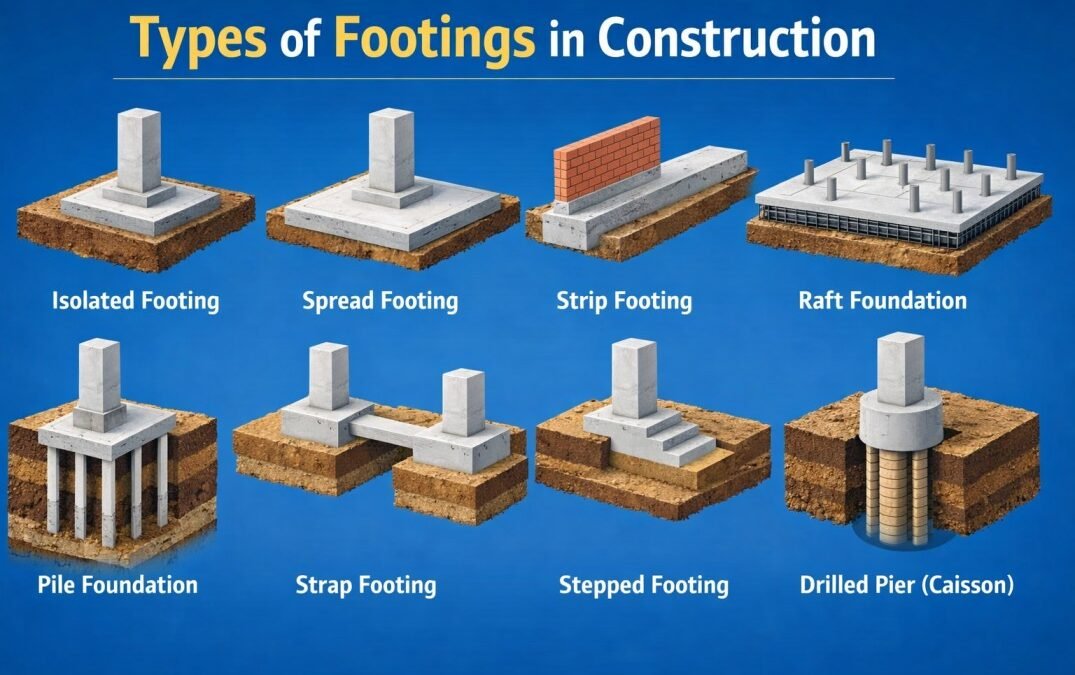
In construction, the foundation is the most critical element of any building. A strong foundation ensures stability, durability, and safety. At the heart of every foundation lies the footing—the structural base that transfers building loads into the soil. Choosing the right type of footing is essential, as it directly impacts the performance and longevity of the structure.
This article explores the different types of footings in construction, their applications, advantages, and suitability for various projects. Whether you’re a builder, engineer, or homeowner, understanding footings will help you make informed decisions for your project.
What Are Footings in Construction?
Footings are structural components placed below the foundation to distribute the load of the building evenly into the ground. They prevent excessive settlement, cracks, and structural failure. The choice of footing depends on factors such as:
- Soil type and bearing capacity
- Load intensity and distribution
- Type of structure (residential, commercial, industrial)
- Environmental and site conditions
Types of Footings in Construction
1. Isolated Footings
- Definition: Individual footings provided under each column.
- Shape: Square, rectangular, or circular.
- Application: Common in residential buildings with moderate loads.
- Benefit: Simple design, cost-effective, and easy to construct.
2. Spread Footings (Pad Footings)
- Definition: Footings that spread the load over a larger area.
- Application: Suitable for soils with good bearing capacity.
- Benefit: Economical and widely used in small to medium projects.
3. Strip Footings
- Definition: Continuous footing provided under load-bearing walls.
- Application: Distributes loads evenly along the wall length.
- Benefit: Common in low-rise housing and small commercial projects.
4. Raft (Mat) Foundation
- Definition: A large slab covering the entire building footprint.
- Application: Ideal for weak soils or when loads are heavy.
- Benefit: Provides uniform load distribution, reduces differential settlement.
- Use Case: Basements, hospitals, industrial buildings.
5. Pile Foundations
- Definition: Deep foundations using long, slender columns driven into the ground.
- Application: Transfers loads to deeper, stronger soil layers.
- Benefit: Essential for high-rise buildings and poor soil conditions.
- Use Case: Towers, bridges, apartments, and coastal projects.
6. Strap Footings
- Definition: Two isolated footings connected with a strap beam.
- Application: Used when columns are close and soil bearing capacity is low.
- Benefit: Prevents differential settlement and balances uneven loads.
7. Stepped Footings
- Definition: Footings constructed with steps to reduce concrete volume.
- Application: Common in sloping sites or uneven ground.
- Benefit: Economical and practical for small projects.
8. Sloped Footings
- Definition: Similar to stepped footings but with a sloping surface.
- Application: Provides better load distribution.
- Benefit: Aesthetic and cost-efficient, often used in residential projects.
9. Drilled Piers (Caissons)
- Definition: Large diameter shafts drilled into the ground.
- Application: Transfers heavy loads to deep strata.
- Benefit: Suitable for bridges, towers, and heavy industrial structures.
Comparison Table
| Footing Type | Depth | Best For | Common Use |
|---|---|---|---|
| Isolated | Shallow | Individual columns | Homes, small offices |
| Spread | Shallow | Moderate loads | Residential, commercial |
| Strip | Shallow | Load-bearing walls | Low-rise housing |
| Raft | Shallow | Weak soils, heavy loads | Hospitals, basements |
| Pile | Deep | Poor soil, high-rise | Towers, apartments |
| Strap | Shallow | Close columns | Industrial sheds |
| Stepped | Shallow | Sloping sites | Small projects |
| Sloped | Shallow | Cost efficiency | Residential |
| Caissons | Deep | Heavy loads | Bridges, plants |
Importance of Choosing the Right Footing
- Structural Safety: Prevents cracks and collapse.
- Cost Efficiency: Optimizes material usage and reduces wastage.
- Durability: Ensures long-term stability of the building.
- Compliance: Meets regulatory and engineering standards.
- Adaptability: Matches soil conditions and project requirements.
Frequently Asked Questions (FAQs)
Q1: Which footing is most common in residential construction?
A: Isolated and strip footings are most common due to their cost-effectiveness and suitability for moderate loads.
Q2: When should raft foundations be used?
A: Raft foundations are ideal when soil has low bearing capacity or when loads are heavy and spread across a large area.
Q3: Are pile foundations expensive?
A: Yes, pile foundations are costlier but essential for high-rise buildings or poor soil conditions where shallow footings won’t work.
Q4: What is the difference between stepped and sloped footings?
A: Stepped footings reduce concrete volume with steps, while sloped footings distribute loads more evenly with a sloping surface.
Q5: How do I choose the right footing for my project?
A: Consult a structural engineer who will assess soil type, load requirements, and project design before recommending the best footing.