
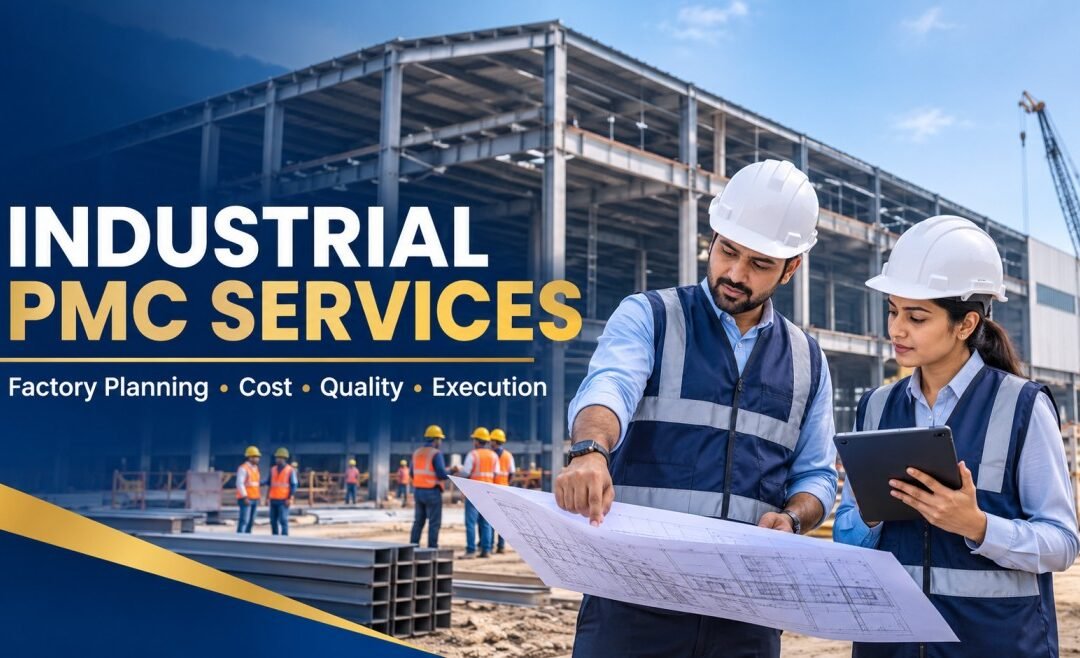
Building a factory is not simply about constructing walls, installing a roof, and completing the civil work. An industrial construction project involves several interconnected activities, including structural planning, machinery requirements, utility coordination, contractor management, procurement, budgeting, quality control, and safety compliance. Even a small coordination gap can lead to delays, unexpected expenses, or problems during factory operations.
This is where Industrial PMC Services become important. A Project Management Consultant (PMC) helps factory owners and industrial developers plan, coordinate, monitor, and control construction activities from the initial planning stage to project handover.
For businesses planning a new manufacturing unit, factory expansion, industrial shed, or warehouse, a professional PMC can provide better visibility over project costs, timelines, quality, and execution.
What Are Industrial PMC Services?
Industrial Project Management Consultancy refers to professional management and coordination services for industrial construction projects. A PMC works on behalf of the project owner to coordinate the different stakeholders involved in construction and monitor whether the project is progressing according to approved plans, specifications, budgets, and timelines.
Depending on the agreed scope, an industrial PMC may coordinate architects, structural consultants, MEP consultants, contractors, vendors, suppliers, and site teams.
Industrial PMC services may be required for:
- Manufacturing plants and production facilities
- Automotive and engineering factories
- Industrial sheds and pre-engineered buildings (PEB)
- Warehouses and logistics facilities
- Packaging and processing units
- Factory extensions and capacity expansion projects
- Industrial infrastructure and utility development
The exact responsibilities depend on the project’s size, complexity, and the services agreed with the client.
Our Industrial Projects:
Industrial Projects By AKS Realtech
What Does a Project Management Consultant Do for a Factory?
A factory construction PMC is responsible for bringing different project activities together under a structured management process. Here are the key responsibilities.
1. Project Planning and Feasibility Assessment
Before construction begins, the project requirements need to be clearly understood. A PMC helps the owner review the project objectives, proposed facility requirements, available site information, expected budget, and target completion schedule.
For a factory, planning may include:
- Understanding the manufacturing process and operational requirements
- Reviewing proposed building layouts and space requirements
- Coordinating discussions with design and engineering consultants
- Identifying major construction milestones
- Preparing an initial project execution strategy
- Highlighting potential project risks and dependencies
For example, a manufacturing facility may require specific production areas, loading and unloading zones, internal movement routes, utility spaces, and provisions for future expansion. These requirements should be considered before construction decisions are finalized.
2. BOQ Preparation and Construction Budgeting
An inaccurate budget can create serious problems during factory construction. Missing quantities, unclear specifications, incomplete scope descriptions, and unplanned variations can increase the overall project cost.
A PMC or cost consultancy team can help prepare or review the Bill of Quantities (BOQ), assess quantities, organize cost estimates, and establish a project budget based on available drawings and specifications.
Typical cost-management activities include:
- Quantity take-offs from drawings
- BOQ preparation and review
- Material and labour cost assessment
- Budget allocation for different work packages
- Cost comparison of contractor quotations
- Monitoring approved variations and additional work
- Reviewing contractor bills against measured work
A properly structured BOQ gives the owner a clearer understanding of what is included in the project and provides a reference for comparing contractor quotations.
3. Design and Engineering Coordination
Industrial buildings often involve multiple technical disciplines. Civil and structural drawings must work together with electrical systems, plumbing, fire safety, ventilation, drainage, and other building services.
A PMC helps coordinate the inputs of different consultants and identifies design-related gaps that may affect site execution.
For example, a mismatch between structural provisions and equipment requirements may require costly changes if identified after construction has progressed. Similarly, inadequate coordination of electrical loads, utility routes, or equipment access can affect future factory operations.
The PMC’s role is to facilitate timely coordination and ensure that relevant issues are reviewed by the responsible technical consultants before work proceeds.
4. Contractor and Vendor Coordination
Factory construction may involve several contractors for civil work, structural steel, PEB systems, electrical installations, plumbing, fire protection, flooring, and other specialized activities.
Without proper coordination, contractors may face delays due to incomplete preceding work, material availability, drawing revisions, or site-access issues.
A PMC can support the owner through:
- Coordinating contractors and specialist agencies
- Reviewing work schedules and dependencies
- Monitoring contractor performance
- Coordinating material and equipment requirements
- Tracking pending approvals and site decisions
- Communicating progress and execution issues to the client
This creates a more organized working environment and helps reduce avoidable coordination gaps.
5. Site Supervision and Quality Monitoring
Construction quality has a direct impact on the safety, durability, maintenance, and operational performance of an industrial facility.
A PMC may monitor site activities against approved drawings, specifications, quality requirements, and the agreed inspection process. The actual inspection and approval responsibilities should be clearly defined in the PMC contract and technical scope.
Depending on the project, quality monitoring may cover:
- Excavation and foundation activities
- Reinforcement and concrete work
- Structural steel and PEB installation
- Masonry and industrial flooring
- Waterproofing and finishing
- Electrical and plumbing installations
- Fire and safety-related work
- Material inspections and test documentation
Issues identified during construction can be reported to the client and responsible contractor or consultant for corrective action.
6. Project Schedule and Progress Monitoring
Delays in factory construction can affect machinery installation, recruitment, production planning, lease commitments, and business launch schedules.
A PMC helps establish a project schedule with defined activities, milestones, dependencies, and target dates. Progress can then be compared against the approved programme.
Regular monitoring may include:
- Weekly or monthly progress reviews
- Tracking completed and pending activities
- Identifying schedule slippages
- Reviewing reasons for delays
- Following up on contractor commitments
- Reporting critical decisions and corrective actions
The objective is not simply to report delays, but to identify issues early enough for the project team to evaluate corrective measures.
7. Cost Control and Value Engineering
Cost control is more than selecting the lowest quotation. Industrial construction requires a balance between initial investment, structural performance, operational requirements, durability, and future maintenance.
Value engineering reviews can help identify alternative materials, specifications, construction methods, or design solutions that may provide better value without compromising essential performance or safety requirements.
For instance, alternative structural arrangements or construction methods may be evaluated for a suitable industrial building. Any proposed change should be checked by the relevant design professionals and assessed against technical specifications, applicable codes, and long-term operating needs.
A PMC can help the client compare options, understand cost implications, and document decisions.
8. Documentation, Reporting and Project Handover
Proper documentation helps maintain accountability throughout the project. It also supports future maintenance, repairs, audits, and facility operations.
Depending on the agreed scope, project documentation may include:
- Approved drawings and revisions
- BOQs, estimates, and variation records
- Meeting minutes and progress reports
- Material approvals and inspection records
- Contractor bills and measurement records
- Testing and commissioning documents
- Completion records and handover documentation
At the handover stage, the PMC may coordinate the closure of pending work, collection of relevant documents, and transfer of project information to the owner or facility team.
Why Do Factory Owners Need an Industrial PMC?
Factory owners often have to manage construction alongside their core business responsibilities. Coordinating multiple contractors, checking bills, reviewing progress, and resolving technical issues can consume significant time.
A structured PMC arrangement can help owners:
- Maintain better control over project budgets
- Improve visibility into construction progress
- Coordinate multiple contractors and consultants
- Identify execution and design coordination issues earlier
- Monitor workmanship and specified quality requirements
- Track changes, variations, and additional costs
- Maintain organized project records
- Prepare more effectively for project completion and handover
A PMC does not automatically guarantee zero delays or cost overruns. Its value depends on the consultant’s technical capability, clearly defined responsibilities, timely reporting, and the client’s decision-making process.
When Should You Hire a PMC for Factory Construction?
The best time to involve a PMC is generally during the early planning stage, before major design, procurement, and contractor commitments are finalized.
However, a PMC can also be appointed when a project is already underway and the owner needs support with cost monitoring, contractor coordination, site supervision, or progress reporting.
Consider engaging a PMC when:
- You are planning a new factory or manufacturing unit.
- You are developing a warehouse or industrial shed.
- Your project involves multiple contractors and specialist vendors.
- You need BOQ preparation, cost planning, or quotation evaluation.
- You want regular site progress and quality reports.
- Your existing project is facing coordination or cost-control challenges.
How to Choose the Right Industrial PMC Company
Before appointing a Project Management Consultant for your factory, evaluate more than the company’s website or general construction experience.
Consider these factors:
- Relevant industrial experience: Ask about factory, manufacturing, warehouse, or industrial shed projects similar to yours.
- Clear scope of services: Confirm whether the engagement includes planning, BOQ, cost control, contractor coordination, site supervision, reporting, and handover.
- Technical coordination capability: Understand how the PMC coordinates civil, structural, electrical, mechanical, and other specialist consultants.
- Reporting process: Ask how often you will receive progress updates, cost reports, and issue trackers.
- Project team: Understand who will manage the project and who will be responsible for site-level coordination.
- Transparent commercial terms: Review the fee structure, deliverables, exclusions, site-visit frequency, and responsibilities in writing.
- Verifiable project references: Request relevant project details, photographs, client references, and evidence of the PMC’s actual role.
A good PMC partner should be able to explain its working process clearly and align its services with your project requirements.
Industrial Project Management Consultancy by AKS Realtech LLP
AKS Realtech LLP provides Industrial Project Management Consultancy and engineering-related support for factories, manufacturing facilities, warehouses, industrial sheds, and other industrial developments across Delhi NCR and India.
The industrial project portfolio featured on the AKS Realtech website includes projects such as SBP Automotive, Prakash Automotive, Hindustan Polymer, and Hindustan Rubber. The SBP Automotive project page, for example, describes a 10,900 sq. ft. covered PEB industrial facility at IMT Faridabad and lists PMC, cost management, quality assurance, construction supervision, and contractor coordination within its scope.
Depending on project requirements and the agreed engagement, AKS Realtech’s industrial PMC support can cover:
- Project planning and scheduling
- BOQ and cost-management support
- Contractor and vendor coordination
- Construction supervision and progress monitoring
- Quality assurance and reporting
- Project coordination through completion and handover
If you are planning a new factory, expanding an existing manufacturing unit, or developing an industrial warehouse, discuss your requirements with the AKS Realtech team.
Planning an industrial construction project in Delhi NCR?
Contact AKS Realtech LLP to discuss your project type, location, estimated budget, current stage, and PMC requirements.
Call: +91 9811674140 / +91 7838449982
Email: info@chopras.co
Website: https://chopras.co/industrial/
Frequently Asked Questions
Q What is an Industrial PMC?
An Industrial PMC is a Project Management Consultancy that helps factory owners and industrial developers plan, coordinate, monitor, and control construction activities. Its scope may include project scheduling, BOQ, cost management, contractor coordination, site supervision, quality monitoring, and handover support.
Q What services are included in factory construction PMC?
Factory construction PMC services may include feasibility and project planning, design coordination, BOQ and budgeting, tender assistance, contractor management, site supervision, progress monitoring, cost control, quality coordination, documentation, and handover.
Q Is PMC required for a small factory project?
PMC can be useful for small and medium-sized factory projects when the owner needs professional support with budgeting, contractor coordination, quality monitoring, or timelines. The appropriate scope should be based on project complexity and the owner’s internal capabilities.
Q What is the difference between a PMC and a construction contractor?
A construction contractor is generally responsible for executing the contracted construction work. A PMC typically represents or supports the project owner by coordinating stakeholders and monitoring project delivery against agreed requirements. The exact responsibilities depend on the contract and project structure.
Q Can a PMC help control factory construction costs?
Yes. A PMC or cost consultancy team can support BOQ preparation, cost planning, quotation evaluation, bill verification, variation tracking, and value engineering. These activities improve cost visibility and help the owner make informed financial decisions.
Q Does AKS Realtech provide Industrial PMC services in Delhi NCR?
AKS Realtech LLP lists industrial project management consultancy services for factories, manufacturing facilities, warehouses, and industrial developments across Delhi NCR and India. Contact the team to confirm service availability and the scope suitable for your project.